LX Electric Single Girder Suspension Overhead Crane
Our LX electric single girder suspension overhead crane features a rigid structure, efficient operation, and economical performance. It is widely used for light-duty material handling in workshops and other industrial facilities. By suspending the crane from overhead runway beams or supporting steel structures, it can help save floor space without requiring a separate ground-supported crane runway. Lifting capacity, lifting height, control method, and other specifications can be customized to meet your specific working conditions.
Technical Specifications of LX Suspension Overhead Crane
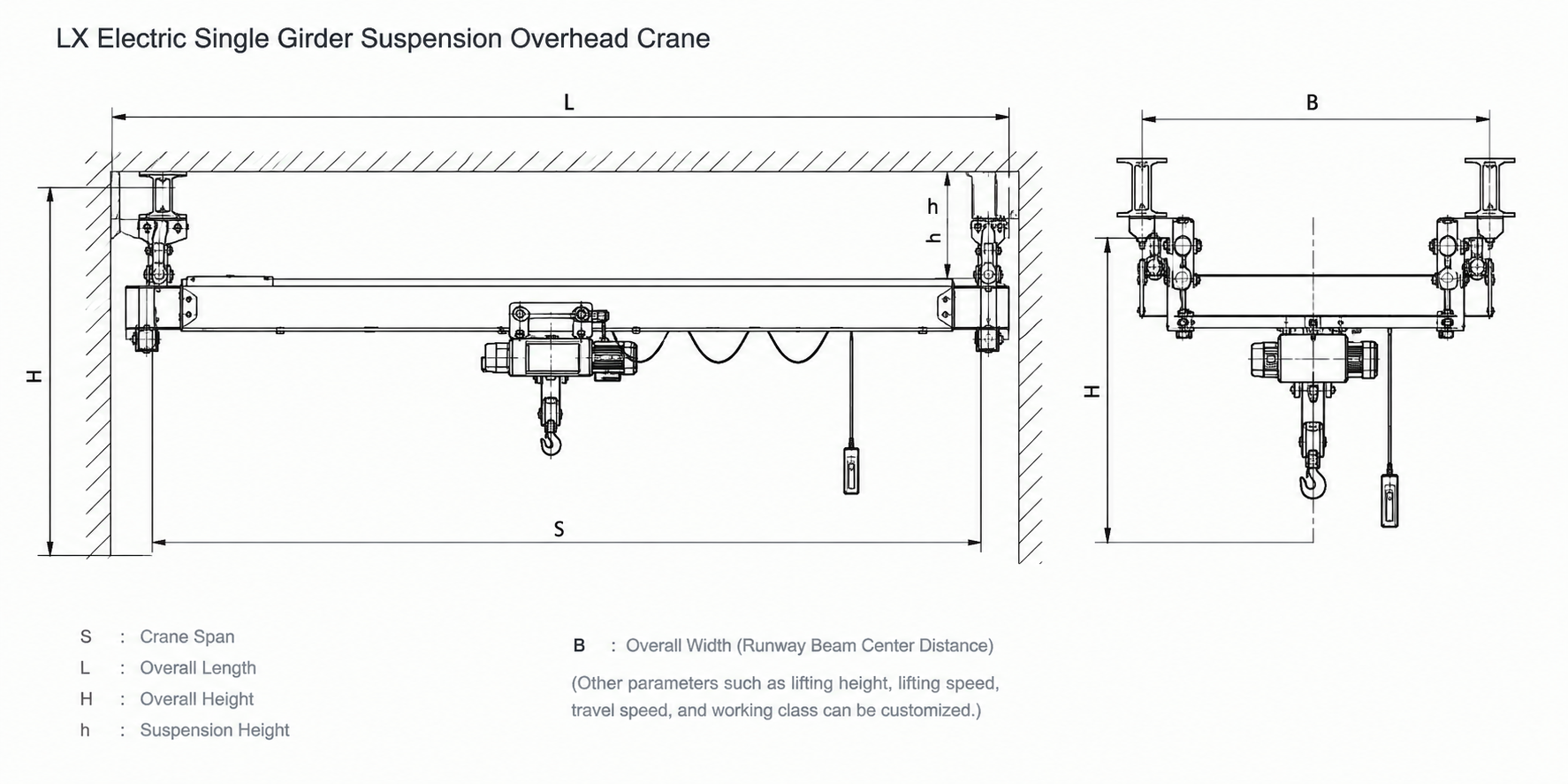
The following table provides preliminary reference specifications for common LX single girder suspension overhead crane configurations. Actual dimensions and operating speeds should be confirmed according to the final engineering drawings and selected components.
Parameter |
Symbol |
Unit |
0.5 t |
1 t |
2 t |
3 t |
5 t |
Rated Lifting Capacity |
Q |
kg |
500 |
1,000 |
2,000 |
3,000 |
5,000 |
Crane Span |
S |
mm |
6,000 |
8,000 |
8,000 |
7,000 |
6,000 |
Overall Length |
L |
mm |
6,500 |
8,500 |
8,500 |
7,500 |
6,500 |
Overall Height |
H |
mm |
650 |
750 |
850 |
950 |
1,100 |
Suspension Height |
h |
mm |
250 |
280 |
320 |
350 |
400 |
Lifting Height |
H₁ |
m |
6 |
6 |
6 |
6 |
6 |
Lifting Speed |
V₁ |
m/min |
8 |
8 |
8 |
8 |
8 |
Cross Travel Speed |
V₂ |
m/min |
20 |
20 |
20 |
20 |
20 |
Long Travel Speed |
V₃ |
m/min |
20 |
20 |
20 |
20 |
20 |
Control Method |
— |
— |
Pendant / Radio Remote |
Pendant / Radio Remote |
Pendant / Radio Remote |
Pendant / Radio Remote |
Pendant / Radio Remote |
Note: The dimensions and speeds above are preliminary reference values, not verified standard specifications. Final parameters depend on the crane design, runway arrangement, hoist configuration, and site conditions.
Design of the LX Single Girder Suspension Overhead Crane
The LX single girder suspension overhead crane is designed for workshops where installing a floor-supported crane runway is difficult or where floor space needs to be kept clear.
How Is an LX Suspension Overhead Crane Supported?
A conventional LD single girder overhead crane is supported by runway rails mounted on brackets or corbels along the workshop columns. The load is transferred from the main girder to the end trucks, runway rails, supporting brackets, columns, and foundations. Therefore, the existing columns, brackets, and foundations must have sufficient load-bearing capacity.
The LX suspension overhead crane uses a different support arrangement. Its suspension travel units run along overhead runway beams, with the crane suspended from the lower flanges of the supporting beams.
The load is transferred through the main girder, suspension travel units, and runway beams to the building's supporting structure. The overhead beams, connections, and supporting structure must be checked for the additional loads generated by the crane, including its self-weight, lifted load, and operating forces.
When Should You Consider an LX Suspension Crane?
An LX suspension crane may be suitable when:
→Floor space is limited and needs to remain available for production, storage, or vehicle movement.
→Installing new ground-supported columns and crane runway structures would be difficult or costly.
→The workshop already has suitable overhead runway beams or supporting steel structures.
→The required lifting capacity, span, and lifting height can be accommodated by the available building structure.
→However, an LX crane is not suitable for every workshop without columns. The existing overhead structure must have sufficient load-bearing capacity, and the suspension points, runway beams, and connections must be checked before installation.
Limitations of the LX Suspension Overhead Crane
The LX design also has limitations that should be considered during crane selection.
Because the crane runs below the supporting beams, the available headroom and effective hook height may be restricted. The maximum span and lifting capacity may also be limited by the runway arrangement, suspension design, and load-bearing capacity of the building structure.
For applications requiring greater lifting capacity or a different runway arrangement, a conventional LD top-running single girder overhead crane may be worth comparing. The final choice should be based on the required lifting height, floor layout, structural conditions, and total installation cost rather than the crane type alone.
Customized LX Suspension Overhead Crane Solutions from Mine Crane
Different workshops have different structural conditions and material-handling requirements. Mine Crane can customize the LX electric single girder suspension overhead crane according to the project requirements.
Customization options may include:
Rated lifting capacity: Selected according to the weight of the heaviest load and the intended operating conditions.
Crane span: Determined by the required working coverage and the arrangement of the overhead runway beams.
Lifting height: Selected according to the height of the load, the required lifting position, and available headroom.
Control method: Pendant control or radio remote control, depending on the application.
Hoisting mechanism: CD1 or MD1 wire rope electric hoist, subject to the required lifting capacity, lifting height, and configuration.
Special working environments: Explosion-proof or corrosion-resistant configurations can be discussed according to the environmental conditions and applicable technical requirements.
Before a customized LX overhead crane is designed, the buyer should provide the required lifting capacity, span, lifting height, building drawings or runway beam dimensions, and expected working frequency. These details help determine whether the suspension arrangement is suitable and what modifications may be required.
FAQ
Q:What is the lifting capacity of an LX suspension overhead crane?
A:The LX suspension overhead crane is generally used for lifting capacities from 0.5 to 10 tonnes, although the available capacity depends on the model and supporting structure. Capacities above 10 tonnes are less common for this type of crane and require careful assessment of the overhead structure and suspension arrangement.
The lifting capacity should not be selected based only on the weight of the hoist or main girder. The complete load path, including the runway beams, connections, and building structure, must be considered.
Q:Can Mine Crane customize an LX single girder suspension overhead crane?
A:Yes. Mine Crane can discuss customized lifting capacity, crane span, lifting height, control method, and other configuration requirements. Explosion-proof or corrosion-resistant options may also be available, depending on the working environment and design requirements.
Q:Which electric hoist is used on an LX suspension overhead crane?
A:CD1 or MD1 wire rope electric hoists can be considered for LX crane configurations. The final hoist selection depends on the rated lifting capacity, lifting height, lifting speed, duty requirements, and available headroom.
Q:What is the difference between an LX suspension overhead crane and an LD overhead crane?
A:The main difference is the support and running arrangement. An LX crane is suspended from overhead runway beams, while an LD top-running crane runs on rails supported by brackets or corbels on the workshop columns.
The LX arrangement can help keep the floor clear and may avoid the need for a separate ground-supported runway. However, it requires a suitable overhead supporting structure. An LD crane transfers its loads through its runway rails, brackets, columns, and foundations, so the capacity of those components must also be checked.
Q:Is an LX suspension overhead crane cheaper than an LD overhead crane?
A:An LX crane may be more economical when the existing overhead structure is suitable and a separate ground-supported runway would otherwise need to be installed. However, the total cost depends on the crane specifications, required structural reinforcement, installation work, and site conditions.
If the overhead beams need substantial reinforcement, the LX option may not offer a cost advantage. Comparing the complete installed cost of both solutions is therefore recommended.


 Single girder overhead crane


