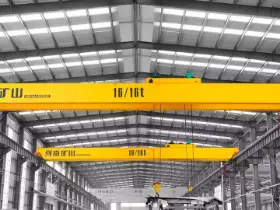
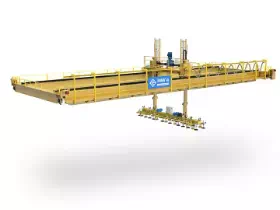
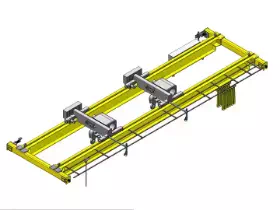
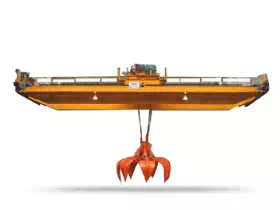
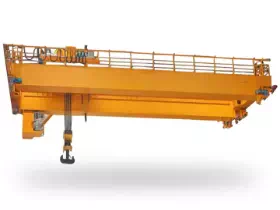
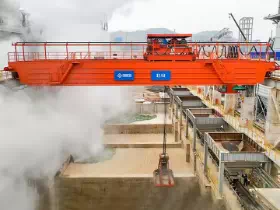
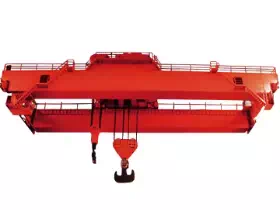
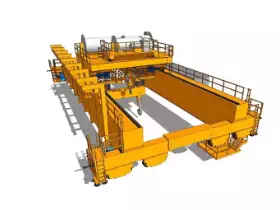
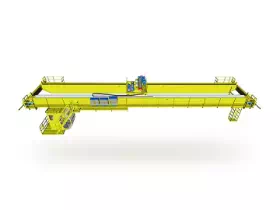
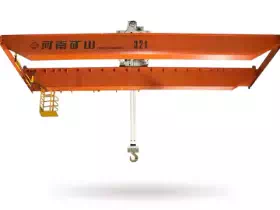
The Double Girder Overhead Crane with Hook is widely used in industrial workshops for lifting and handling heavy loads. Compared with a single girder structure, the double girder design offers greater load-bearing capacity and higher structural rigidity, making it suitable for lifting operations involving larger spans and heavier loads.
This double girder hook overhead crane uses a hook as the lifting attachment and is equipped with a winch trolley as the hoisting mechanism. It is widely used for frequent handling of heavy materials such as steel, profiles, billets, and molds.
The crane features box-type main girders fabricated from steel plates. The welds undergo ultrasonic testing (UT) to check their quality. The steel structure is shot-blasted to Sa 2.5 and coated with an epoxy anti-corrosion finish to improve corrosion resistance and extend its service life. Product design and manufacturing can be carried out in accordance with relevant ISO, CE, and FEM 1.001 requirements.
If you are looking for a high-quality Double Girder Overhead Crane with Hook, welcome to contact Mine Crane. Please provide your required lifting capacity, span, lifting height, and actual working conditions. We will recommend a suitable crane configuration and provide a quotation based on your requirements.
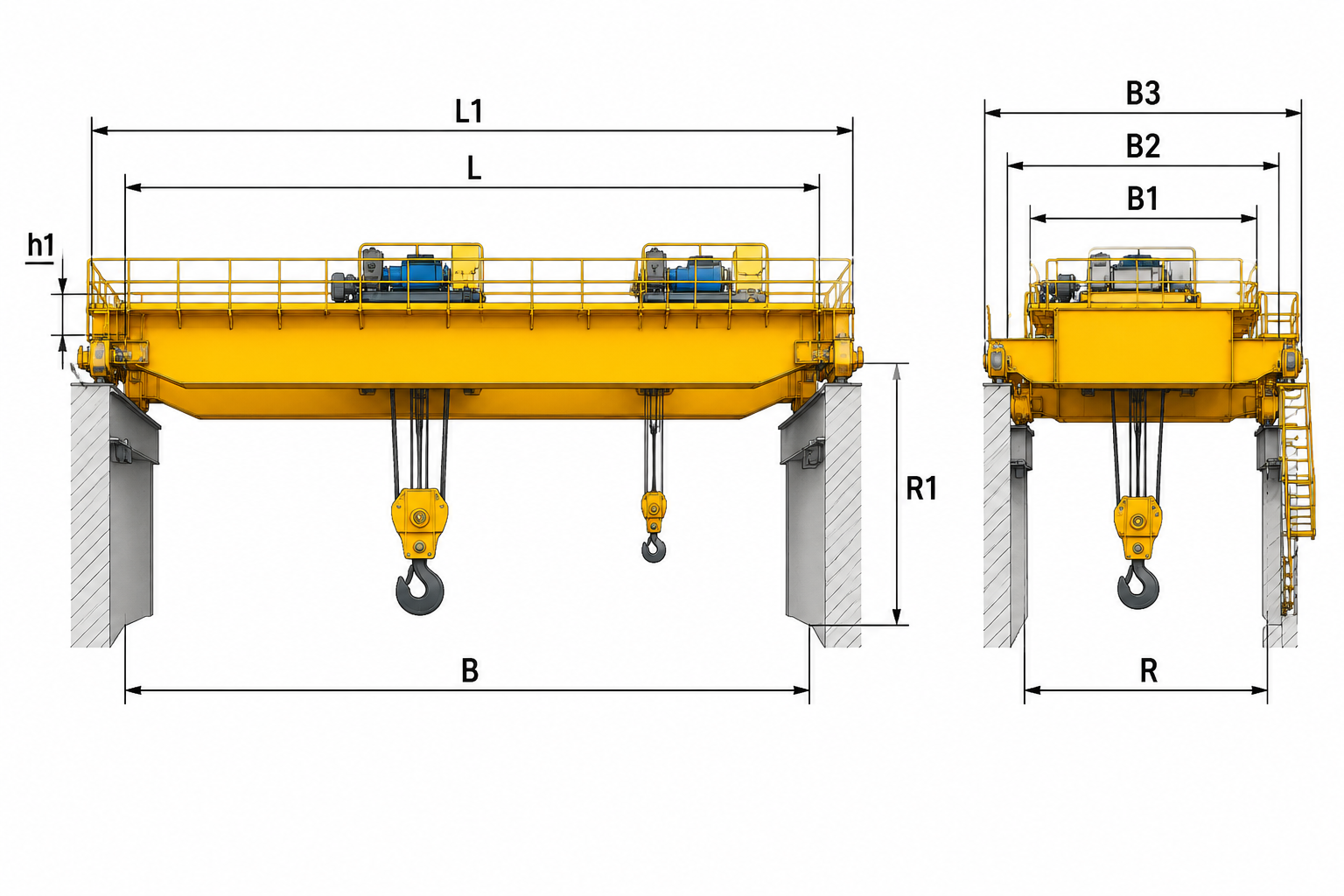
Technical Specifications of Double Girder Overhead Crane with Hook
Item |
Unit |
16.5 |
19.5 |
22.5 |
25.5 |
28.5 |
31.5 |
34.5 |
35.5 |
Main Hook Capacity |
t |
500 (550 optional) |
500 |
500 |
500 |
500 |
500 |
500 |
500 |
Auxiliary Hook Capacity |
t |
100 |
100 |
100 |
100 |
100 |
100 |
100 |
100 |
Span (S) |
m |
16.5 |
19.5 |
22.5 |
25.5 |
28.5 |
31.5 |
34.5 |
35.5 |
Lifting Height (Main / Auxiliary Hook) |
m |
20 / 22 |
20 / 22 |
20 / 22 |
20 / 22 |
20 / 22 |
20 / 22 |
20 / 22 |
20 / 22 |
Duty Class |
— |
A7 |
A7 |
A7 |
A7 |
A7 |
A7 |
A7 |
A7 |
Main Hoist Speed |
m/min |
1.5 |
1.5 |
1.5 |
1.5 |
1.5 |
1.5 |
1.5 |
1.5 |
Auxiliary Hoist Speed |
m/min |
4.5 |
4.5 |
4.5 |
4.5 |
4.5 |
4.5 |
4.5 |
4.5 |
Trolley Travel Speed |
m/min |
10.5 |
10.5 |
10.5 |
10.5 |
10.5 |
10.5 |
10.5 |
10.5 |
Bridge Travel Speed |
m/min |
32 |
32 |
35 |
35 |
38 |
38 |
40 |
40 |
Overall Dimension L1 |
mm |
1500 |
1500 |
1500 |
1500 |
1500 |
1500 |
1500 |
1500 |
Overall Dimension L |
mm |
1100 |
1100 |
1100 |
1100 |
1100 |
1100 |
1100 |
1100 |
Overall Dimension h1 |
mm |
150 |
150 |
150 |
150 |
150 |
150 |
150 |
150 |
Dimension B1 |
mm |
900 |
900 |
900 |
900 |
900 |
900 |
900 |
900 |
Dimension B2 |
mm |
2800 |
2800 |
2800 |
2800 |
2800 |
2800 |
2800 |
2800 |
Dimension B3 |
mm |
3200 |
3200 |
3600 |
3600 |
4000 |
4000 |
4400 |
4400 |
Dimension R |
mm |
350 |
350 |
400 |
400 |
480 |
480 |
560 |
560 |
Dimension R1 |
mm |
5200 |
5200 |
5200 |
5200 |
5200 |
5200 |
5200 |
5200 |
Dimension B |
mm |
2000 |
2000 |
3200 |
3200 |
3200 |
3200 |
3200 |
3200 |
Max. Wheel Load |
kN |
320 |
335 |
350 |
370 |
390 |
410 |
435 |
455 |
Total Motor Power |
kW |
215 |
215 |
225 |
225 |
235 |
235 |
245 |
245 |
Power Supply |
— |
3-phase AC, 380V, 50Hz |
Same |
Same |
Same |
Same |
Same |
Same |
Same |
Features of Double Girder Overhead Crane with Hook
1. Strong Load-Bearing Capacity
The two main girders are fabricated from structural steel plates such as Q235B or Q345B. Combined with appropriate welding processes, internal stiffener plates, and non-destructive testing such as ultrasonic testing (UT), the double girder overhead crane can handle heavy-duty lifting operations, with a maximum lifting capacity of up to 550 tons.
2. Customized Configurations
Basic parameters such as lifting capacity, span, and variable frequency speed control can be customized according to your requirements.
Different crane configurations are also available, including:
European Type Double Girder Overhead Crane with Hook
Traditional Double Girder Overhead Crane with Hook
Explosion-Proof Double Girder Overhead Crane
Metallurgical Double Girder Overhead Crane
Insulated Double Girder Overhead Crane
Mine Crane can provide different configurations according to your workshop conditions and lifting requirements.
3. High Safety
The crane is equipped with standard safety devices, including travel limit switches, an overload limiter, a lifting height limit switch, an emergency stop button, and buffers.
If two or more overhead cranes operate on the same runway, an anti-collision system can also be customized to help prevent collisions between cranes.
4. Long Service Life
Under proper operating conditions and with regular maintenance, the crane can have a service life of 30–50 years.
5. Multiple Hook Options
Different hook types are available according to the lifting requirements, including single hooks, ramshorn hooks, ring hooks, forged hooks, and insulated hooks.
Main and auxiliary hooks can also be configured on the same crane to handle both heavy and lighter loads, allowing one crane to perform two different lifting tasks.
Main Components of Double Girder Overhead Crane with Hook
1. Mechanical Components
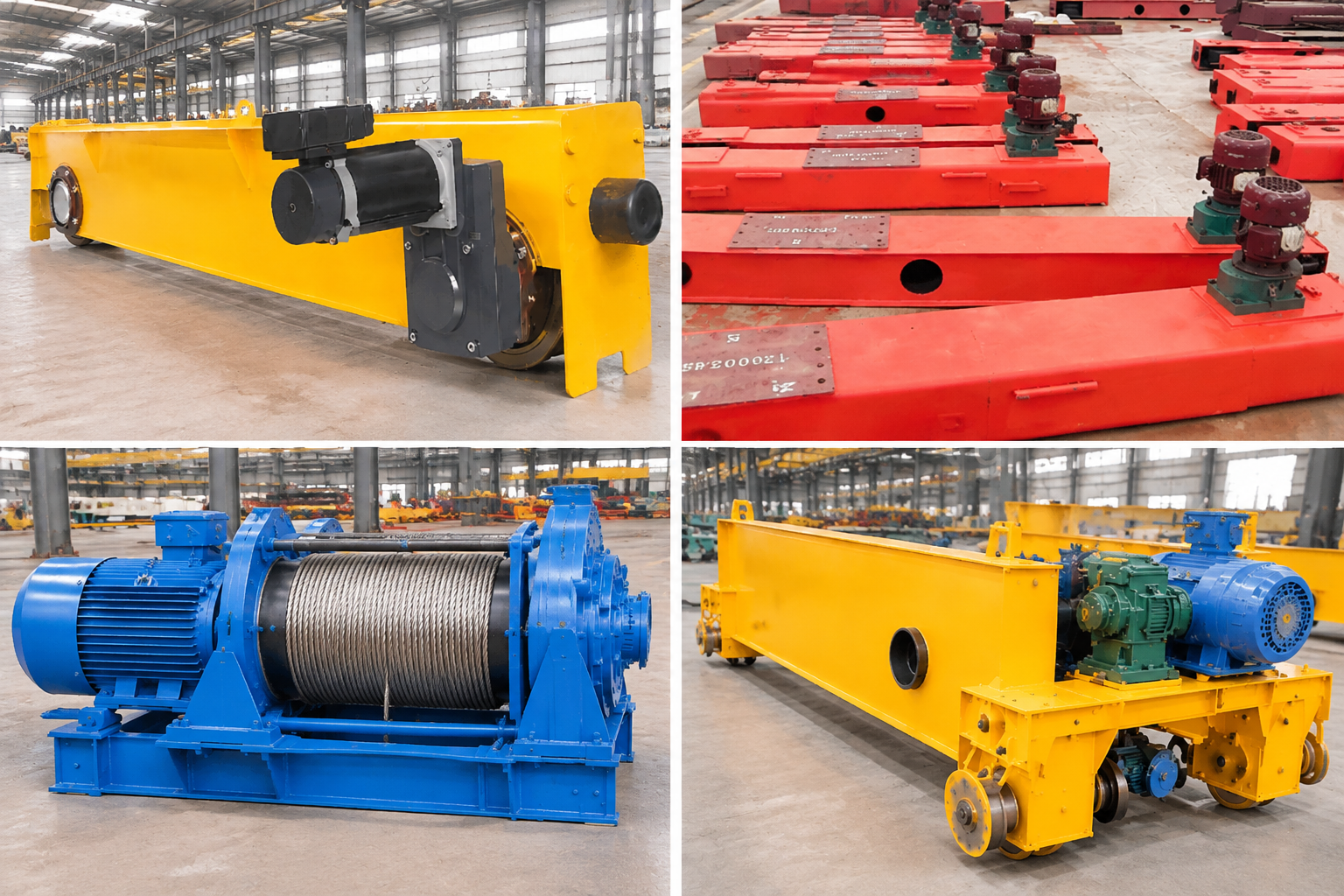
Main Girders
The two main girders are the primary load-bearing components of the crane. They are fabricated from structural steel plates such as Q235B, Q355B, and Q355NL low-temperature steel. The main girders can support loads of up to 500 tons.
End Carriages
The end carriages connect the two ends of the main girders, support the bridge travel mechanism, and drive the entire crane along the runway rails.
Hoisting Mechanism
The hoisting mechanism consists of multiple components, mainly including the winch, hook assembly, pulley blocks, wire rope drum, and brake. These components work together to lift and lower loads.
Travel Mechanism
The travel mechanism consists of the bridge travel mechanism and the trolley travel mechanism.
The wheels are manufactured using a forging process and undergo quenching and tempering heat treatment, followed by high-frequency hardening of the wheel tread. These processes improve wheel strength, hardness, and wear resistance.
2. Electrical Components
Electric Motors
Electric motors convert electrical energy into mechanical energy and provide power for the hoisting mechanism and travel mechanisms. They are the main power source of the double girder hook overhead crane.
Electrical Control Cabinet
The electrical control cabinet manages the crane's electrical control system. Depending on the equipment configuration, a PLC control system can also be used to manage the operating logic of multiple mechanisms, safety interlocks, and automated control functions.
Variable Frequency Drive System
Independent variable frequency drive systems can be provided for the hoisting mechanism, bridge travel mechanism, and trolley travel mechanism.
Variable frequency control supports smooth starting and stopping, as well as stepless speed adjustment, making it suitable for material handling in workshops where precise movement is required.
Operating Units
The crane supports wireless remote control, wired pendant control, and cabin operation.
Customers can select one or more operating methods according to workshop conditions, operating distance, and actual working requirements. A control interlock system can manage the operating permissions of different control units.
3. Safety Protection Devices
Overload Limiter
When the weight of the lifted load exceeds the preset limit, the overload limiter activates an audible alarm and prevents further lifting under overload conditions.
Upper Hoisting Limit Switch and Lowering Depth Limit Switch
When the lifted load reaches the preset upper or lower limit, the crane automatically cuts off the corresponding control circuit to prevent the hook or load from moving beyond the permitted range, helping avoid hazards such as hook over-travel or excessive lowering.
Bridge and Trolley Travel Limit Switches
These limit switches control the travel range of the bridge and trolley, preventing them from moving beyond their normal operating limits and helping avoid collisions, friction, and other accidents.
Emergency Stop Device
In an emergency, the operator can press the emergency stop button to stop crane operation immediately.
Operating Interlock System
When wireless remote control and cabin operation are selected, the interlock system prevents both operating units from controlling the crane at the same time. Only one control unit can be active at a time.


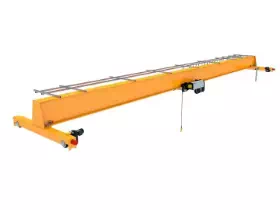


 Explosion Proof Double Girder Overhead Crane